“The booklet is not a complete history. It’s a starting point for more exploration and study,” said Joyce Wilburn, local historian, City of Danville resident, and passionate storyteller.
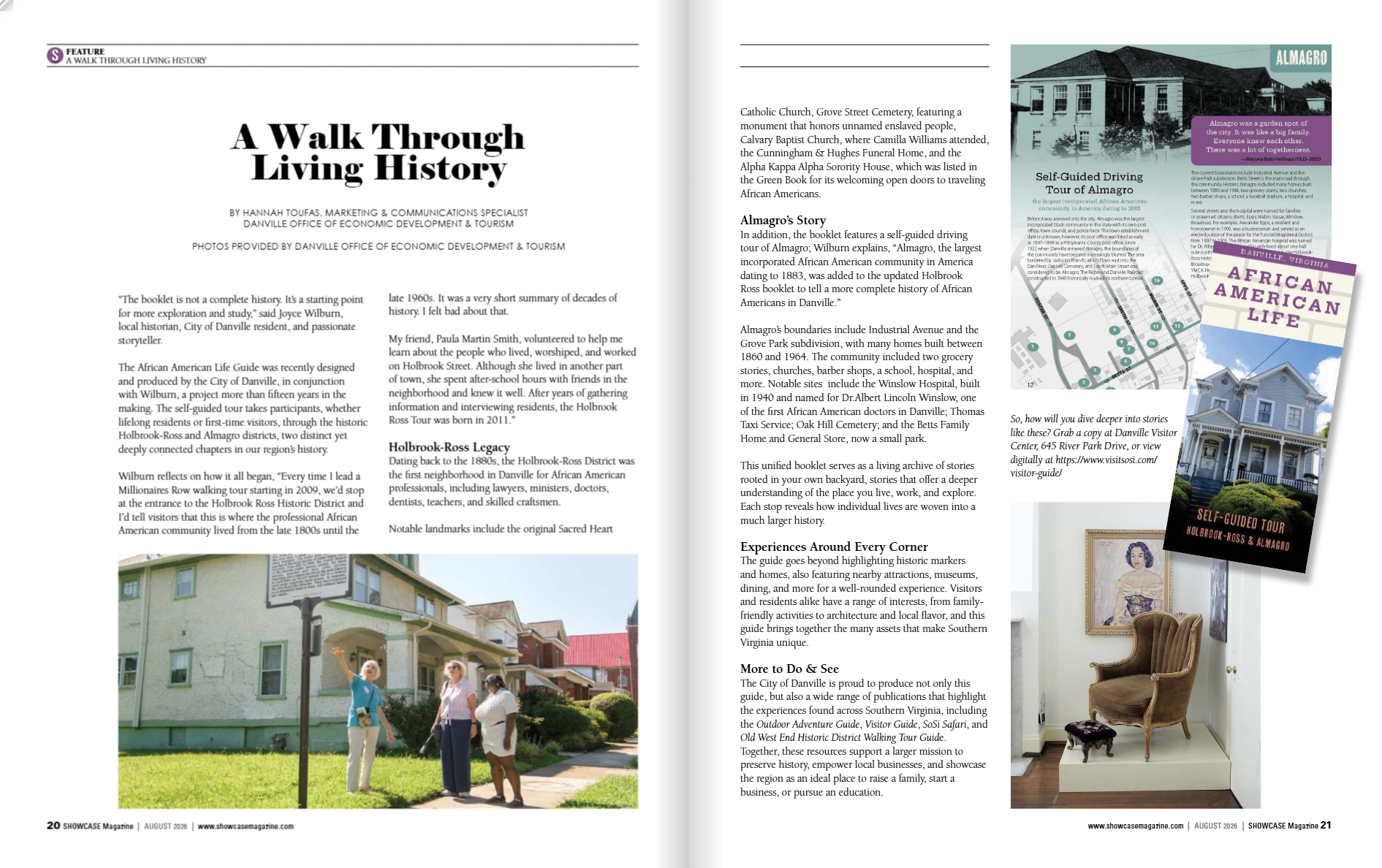
The African American Life Guide was recently designed and produced by the City of Danville, in conjunction with Wilburn, a project more than fifteen years in the making. The self-guided tour takes participants, whether lifelong residents or first-time visitors, through the historic Holbrook-Ross and Almagro districts, two distinct yet deeply connected chapters in our region’s history.
Wilburn reflects on how it all began, “Every time I lead a Millionaires Row walking tour starting in 2009, we’d stop at the entrance to the Holbrook Ross Historic District and I’d tell visitors that this is where the professional African American community lived from the late 1800s until the late 1960s. It was a very short summary of decades of history. I felt bad about that.
My friend, Paula Martin Smith, volunteered to help me learn about the people who lived, worshiped, and worked on Holbrook Street. Although she lived in another part of town, she spent after-school hours with friends in the neighborhood and knew it well. After years of gathering information and interviewing residents, the Holbrook Ross Tour was born in 2011.”
Holbrook-Ross Legacy
Dating back to the 1880s, the Holbrook-Ross District was the first neighborhood in Danville for African American professionals, including lawyers, ministers, doctors, dentists, teachers, and skilled craftsmen.
Notable landmarks include the original Sacred Heart Catholic Church, Grove Street Cemetery, featuring a monument that honors unnamed enslaved people, Calvary Baptist Church, where Camilla Williams attended, the Cunningham & Hughes Funeral Home, and the Alpha Kappa Alpha Sorority House, which was listed in the Green Book for its welcoming open doors to traveling African Americans.
Almagro’s Story
In addition, the booklet features a self-guided driving tour of Almagro; Wilburn explains, “Almagro, the largest incorporated African American community in America dating to 1883, was added to the updated Holbrook Ross booklet to tell a more complete history of African Americans in Danville.”
Almagro’s boundaries include Industrial Avenue and the Grove Park subdivision, with many homes built between 1860 and 1964. The community included two grocery stories, churches, barber shops, a school, hospital, and more. Notable sites include the Winslow Hospital, built in 1940 and named for Dr.Albert Lincoln Winslow, one of the first African American doctors in Danville; Thomas Taxi Service; Oak Hill Cemetery; and the Betts Family Home and General Store, now a small park.
This unified booklet serves as a living archive of stories rooted in your own backyard, stories that offer a deeper understanding of the place you live, work, and explore. Each stop reveals how individual lives are woven into a much larger history.
Experiences Around Every Corner
The guide goes beyond highlighting historic markers and homes, also featuring nearby attractions, museums, dining, and more for a well-rounded experience. Visitors and residents alike have a range of interests, from family-friendly activities to architecture and local flavor, and this guide brings together the many assets that make Southern Virginia unique.
More to Do & See
The City of Danville is proud to produce not only this guide, but also a wide range of publications that highlight the experiences found across Southern Virginia, including the Outdoor Adventure Guide, Visitor Guide, SoSi Safari, and Old West End Historic District Walking Tour Guide.
Together, these resources support a larger mission to preserve history, empower local businesses, and showcase the region as an ideal place to raise a family, start a business, or pursue an education.
So, how will you dive deeper into stories like these? Grab a copy at Danville Visitor Center, 645 River Park Drive, or view digitally at https://www.visitsosi.com/visitor-guide/
Read the original article here (Showcase Magazine, August 2026)